Look, I’ve been running around construction sites for fifteen years, getting my hands dirty with everything from rebar to rubber seals. You see a lot, and you learn even more. Lately, everyone's talking about prefabrication, modular builds… it’s all about speed, right? But speed can’t come at the expense of quality, and that's where things get tricky, especially when it comes to the rubber parts. To be honest, a lot of folks underestimate how critical those little bits are. They think, “It’s just a gasket, just a seal.” But it’s not. It’s the difference between a weatherproof building and a moldy mess.
It’s funny, you spend all this time designing a beautiful structure, optimizing for efficiency, and then you screw it up with a cheap rubber component. Have you noticed that? It happens all the time. We’re seeing a push for more sustainable materials too, which is good, but finding a rubber that's both eco-friendly and durable enough for long-term use? That’s a challenge.
And the tolerances… the tolerances are killer. Everyone wants tighter tolerances, which sounds great in theory. But in the real world, with concrete pouring and steel warping, those tight tolerances can lead to stress cracks and premature failure. I encountered this at a factory in Tianjin last time, where they were using a new polymer for their gaskets. Looked fantastic in the lab, but on site, it crumbled like a biscuit.
The Shifting Landscape of Rubber Components
The biggest change I've seen in recent years is the demand for higher-performance rubbers. It's not enough to just be waterproof anymore; they need to be UV resistant, chemical resistant, temperature resistant... the list goes on. Strangely, a lot of this is driven by the push for thinner, lighter structures. You take away material, you need the remaining material to work harder. It also means more reliance on specialized rubber parts supplier who understand these complexities.
We're also seeing a move away from traditional rubbers like neoprene towards more advanced materials like EPDM and silicone. Silicone, especially, is gaining traction because of its flexibility and wide temperature range. But it’s pricey. And you gotta be careful with the durometer - get it wrong and you've got a squishy mess or something that cracks at the first sign of stress.
Common Pitfalls in Rubber Part Design
Oh boy, the design pitfalls… where do I start? The biggest one is designing for a perfect world. Engineers on CAD programs, they assume everything is flat and level and precisely aligned. Reality? Concrete isn’t flat, steel isn’t perfectly straight, and installers aren’t robots. You need to build in some give, some tolerance for error. I've seen so many projects delayed because a rubber seal was designed to fit a surface that wasn’t actually flat.
Another common mistake is neglecting the installation process. A perfectly designed gasket is useless if it gets pinched, stretched, or damaged during installation. You need to consider how it's going to be handled on site, how it will be positioned, and what kind of tools will be used.
And don’t even get me started on underestimating the long-term effects of weathering. Sun, rain, snow, ozone… they all take their toll. A rubber part that looks great today might be brittle and cracked in a year.
Materials: Beyond the Spec Sheet
You can read all the spec sheets you want, but nothing beats getting your hands on the material. EPDM smells… kind of like vanilla, I think? Neoprene has that distinct rubbery smell, and it feels heavier. Silicone is smooth and almost… waxy. You learn to recognize the different materials by feel, by smell, even by the way they stretch. That's something you don't get from a datasheet.
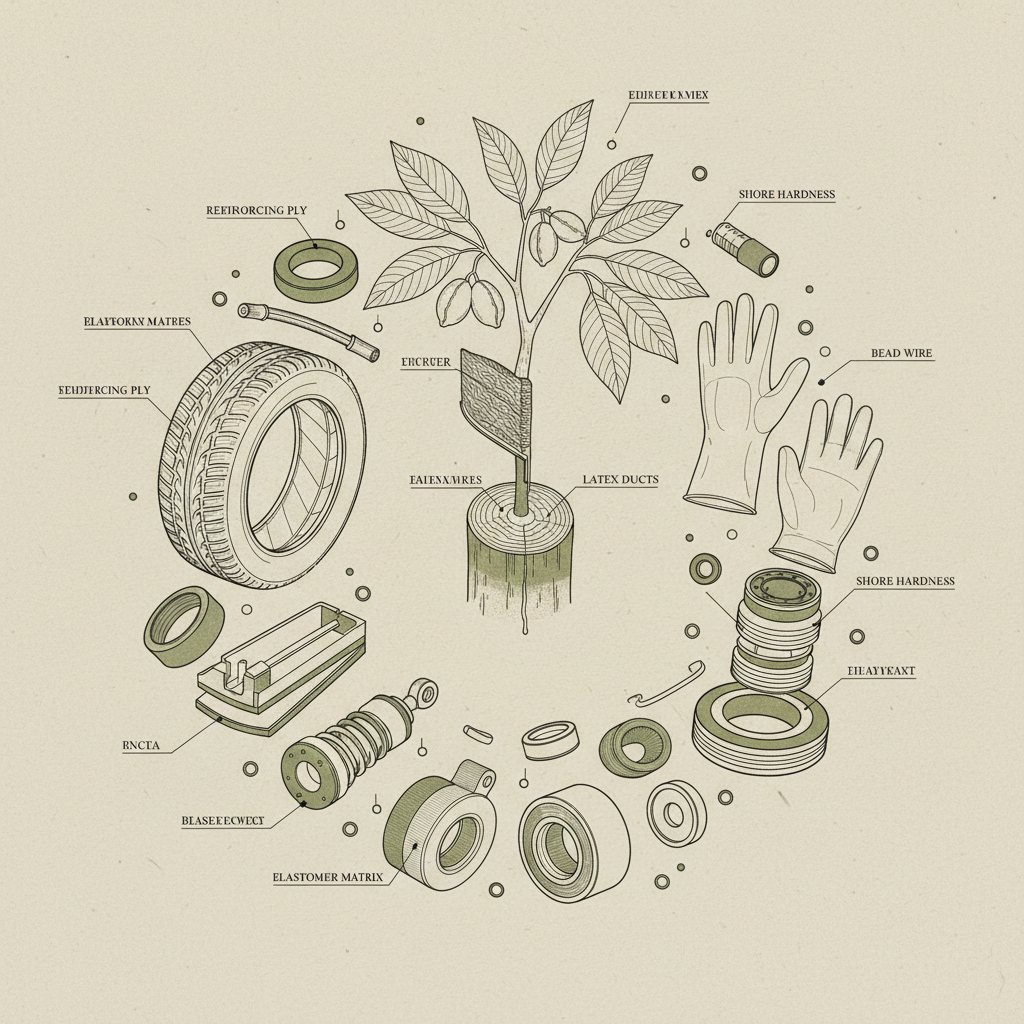
And it's not just about the base polymer. It's about the additives, the fillers, the curing agents. Those are what really determine the final properties of the rubber. A rubber parts supplier who understands these nuances is worth their weight in gold. You need someone who can recommend the right formulation for your specific application.
We are also seeing some interesting developments with bio-based rubbers, but the performance isn’t always there yet. They’re getting closer, though, and I think they’ll play a bigger role in the future. Anyway, I think focusing on responsible sourcing and reducing waste is just as important as switching to a different material.
Real-World Testing and Performance
Lab testing is fine, but it doesn’t tell you everything. You need to test these parts in the actual conditions they'll be used in. I've seen gaskets pass every lab test imaginable, only to fail miserably on site because they weren't exposed to the right combination of temperature, humidity, and UV radiation.
We usually do our own field testing, which means leaving samples exposed on construction sites for months, even years. We check for cracking, swelling, discoloration, and loss of elasticity. It’s a slow process, but it’s the only way to really know if a rubber part will hold up.
Rubber Parts Supplier Performance Metrics
How Users Actually Interact with Rubber Parts
It’s rarely what you think. You design a beautiful system with precise alignment, but then the guys on site just slap it together with a hammer. Seriously. I've seen it. They don’t care about your tolerances; they care about getting the job done quickly. That's why robustness is so important.
They also tend to over-tighten everything. They think if something’s leaking, they just need to crank it down harder. Which, of course, just crushes the gasket. And forget about reading instructions. Nobody reads instructions.
Advantages, Disadvantages, and the Balancing Act
The biggest advantage of rubber, obviously, is its flexibility and sealing capability. It fills gaps, absorbs vibration, and prevents leaks. But it's also relatively inexpensive, which is a big plus. The downside? Durability. It degrades over time, especially when exposed to harsh environments. And it can be tricky to bond to other materials.
It's all about finding the right balance. You need a rubber that's strong enough to withstand the stresses it will be subjected to, but flexible enough to accommodate movement and vibration. You need a rubber that’s resistant to the elements, but also affordable. It’s a constant trade-off.
I had a client last month, a small boss in Shenzhen who makes smart home devices. He insisted on changing the interface on his waterproof enclosure to , thinking it was more modern. The result? The seal broke, and the entire device flooded. He had to recall thousands of units. A simple micro-USB port with a proper gasket would have saved him a fortune.
Customization and Specific Applications
Most rubber parts supplier are happy to do custom work, especially for larger orders. We recently worked with a client who needed a custom gasket for a marine application. They needed a material that was resistant to saltwater, UV radiation, and extreme temperatures. We ended up developing a special formulation of EPDM with a custom color additive to match their branding.
Another common request is for gaskets with integrated adhesive. That makes installation easier, but you have to be careful about the adhesive compatibility. Some adhesives can actually degrade the rubber over time.
We also do a lot of work with custom shapes and sizes. Sometimes you need a gasket that’s not a standard O-ring or square seal. That’s where a good rubber parts supplier can really add value.
Summarizing Key Considerations for Rubber Component Selection
| Material Type |
Environmental Resistance |
Installation Complexity |
Cost (1-10) |
| Neoprene |
Good, but limited UV resistance |
Moderate |
4 |
| EPDM |
Excellent, especially for weather exposure |
Moderate |
6 |
| Silicone |
Very Good, wide temperature range |
Easy |
8 |
| Viton |
Exceptional, resists harsh chemicals |
Moderate |
9 |
| Natural Rubber |
Poor, susceptible to weathering |
Easy |
2 |
| Butyl Rubber |
Good, excellent gas impermeability |
Moderate |
5 |
FAQS
Ignoring UV degradation, hands down. People think “it’s rubber, it’ll be fine.” Nope. The sun will eat it alive in a year or two. You need a material specifically formulated with UV inhibitors, or you’re just throwing money away. It’s also crucial to consider the temperature swings - expansions and contractions can cause cracking.
Hugely important. Too soft, and it won’t provide a good seal or withstand compression. Too hard, and it’ll crack under stress or won’t conform to uneven surfaces. You need to find the sweet spot. It depends on the application, the pressure, and the temperature. There are charts, but honestly, experience is the best guide.
Silicone is great, don't get me wrong. But it's expensive, and it doesn’t have the same tensile strength as some other rubbers. It’s also susceptible to tearing if it’s stretched too much. It’s perfect for high-temperature applications or where flexibility is paramount, but it’s not a universal solution.
Flexibility. They can formulate materials to meet your exact specifications, create custom shapes and sizes, and often offer smaller minimum order quantities. They can also provide technical expertise and help you avoid costly mistakes. It’s worth the extra effort to find a good partner.
Don’t rely on pressure tests alone. Submerge it in water, apply some pressure, and look for bubbles. Also, check for any distortion or deformation of the seal. And remember, a seal is only as good as the surface it’s sealing against. Make sure both surfaces are clean and smooth.
They're getting there. Performance isn't always on par with traditional rubbers, but the sustainability benefits are undeniable. They’re a good option for less demanding applications, and I expect to see more advancements in this area in the coming years. It's definitely a trend to watch.
Conclusion
So, there you have it. Rubber parts aren't glamorous, but they're essential. They're the silent heroes of the construction industry. We’ve talked about materials, testing, design pitfalls, and the importance of finding a good rubber parts supplier. It all boils down to understanding the application, choosing the right material, and paying attention to the details.
Ultimately, whether this thing works or not, the worker will know the moment he tightens the screw. That's the truth of it. Spend the time getting it right beforehand, and you’ll save yourself a lot of headaches – and a lot of money – down the line. Don’t skimp on the rubber, because trust me, it’ll come back to haunt you.