You know, these days everyone's talking about prefabrication. It's all the rage, right? Modular construction, quick assembly… Honestly, it's a good thing, cuts down on waste, speeds things up. But have you noticed? A lot of these designs, they look good on paper, all neat and tidy, but they forget about the real world. About getting your hands dirty. It's like architects have never actually been on a construction site.
And then there’s the push for “green” materials. Totally understandable, don’t get me wrong. But some of this stuff... it feels like it’s been designed to fail. I encountered this at a factory in Zhejiang province last time, they were showing off this new bio-plastic pipe fitting. Smelled… kind of like old socks, to be honest. And it warped in the sun. Just warped.
We primarily work with PVC, of course. Types of pipe fittings PVC, specifically. It’s reliable. You can drop it, bash it, leave it in the rain… it’ll still do its job. That’s not to say it’s perfect. It gets brittle in the cold, and the smell when you’re cutting it… oof. You need good ventilation. But you know what you’re getting. We've been using Schedule 40 and Schedule 80 the most, depending on the pressure requirements. Schedule 80 feels… heavier. More solid. You just get a sense of quality.
The Rise of Prefabrication and PVC Fittings
It's all about speed now, right? Get things done quicker, cheaper. Prefabrication is the answer, and that means a lot more reliance on consistent, easy-to-install components. And that’s where types of pipe fittings PVC come in. They’re not glamorous, but they're essential. I saw a site in Shanghai last year where they were building an entire hospital wing off-site, sections assembled and then just… dropped into place. The plumbing was almost entirely PVC.
But here’s the thing: you still need skilled labor. You can have the fanciest pre-fab components, but if the guys on site don’t know how to put them together properly, it’s all going to fall apart. And that’s where a lot of the problems lie.
Design Pitfalls and Material Choices
Strangely enough, the biggest headaches aren’t always about the materials themselves. It's the design. Engineers will specify something that looks perfect on a CAD drawing, but completely ignores the realities of on-site assembly. Like, they’ll design a complex manifold with a bunch of tight angles, and then expect the plumbers to be able to get a wrench in there. Yeah, right. And then they wonder why it leaks.
We've had a few instances where they've tried to substitute PVC with some of these new composite materials. Look good in the brochure, but they just don't hold up to the abuse. I saw a guy practically snap one in half just trying to thread it. We tried some PEX as well – it’s fine for some things, but the fittings are a pain. Too many different types, too easy to get it wrong.
And then there's the whole issue of compatibility. Mixing different types of plastics… it's a recipe for disaster. You have to be careful about solvents and chemicals, make sure everything is compatible. I learned that the hard way on a project in Guangzhou, had to rip out a whole section of pipe because of galvanic corrosion. Don’t even get me started.
PVC: The Workhorse of Plumbing
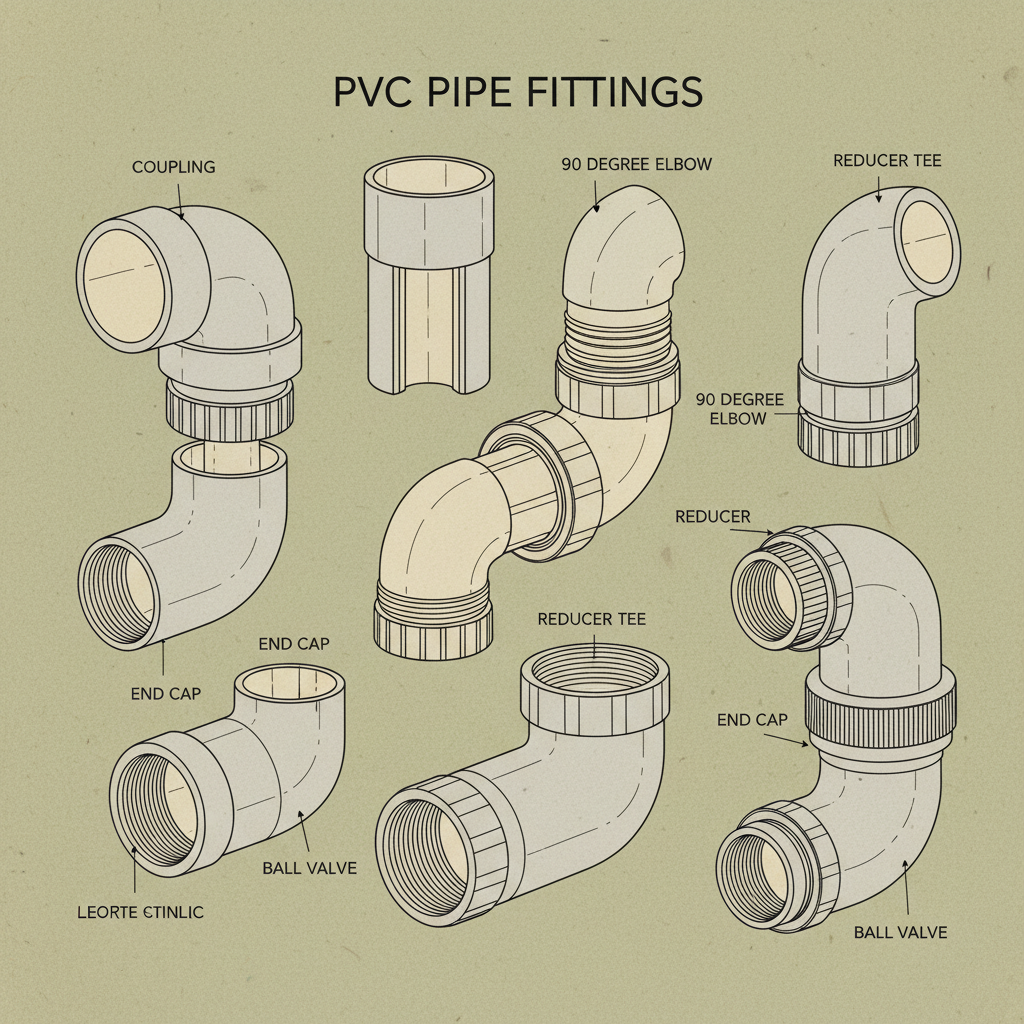
To be honest, PVC is just… reliable. It’s been around for decades, everyone knows how to work with it. You can cut it with a regular saw, glue it with standard PVC cement, and it will hold. It’s not sexy, but it gets the job done. The different types of pipe fittings PVC cover pretty much any scenario you can imagine.
We primarily stock Schedule 40 and Schedule 80. Schedule 40 is your everyday workhorse, good for most residential and commercial applications. Schedule 80 is thicker, stronger, used for higher-pressure systems. The difference in weight is noticeable, and that extra thickness just gives you peace of mind. You know it’s going to handle whatever you throw at it. You can feel it.
The smell… that’s the only downside, really. PVC cement stinks. You need good ventilation. And you need to be careful about applying it properly. Too much, and it gets messy. Too little, and the joint won’t hold. It takes practice, honestly. But once you get the hang of it, it's pretty straightforward.
Real-World Testing and Application
Lab tests are fine, but they don’t tell the whole story. I’ve seen PVC pipe pass all the certification tests, but still fail spectacularly on site. We do our own testing, more… practical testing. We pressure test everything, obviously. But we also drop things, bash them around, expose them to the elements. Just to see how they hold up.
We had a project last year, a wastewater treatment plant, and they wanted to use a thinner-walled PVC pipe to save money. I told them it was a bad idea. I said, “Look, this stuff is going to be buried underground, exposed to chemicals, and subject to heavy loads. You need the extra strength of Schedule 80.” They didn’t listen. And wouldn’t you know it, a section of pipe collapsed six months later. Cost them a fortune to fix.
Durability Comparison of types of pipe fittings pvc
Advantages, Disadvantages, and Customization
Look, PVC isn't perfect. It's not the strongest material, it's not the most environmentally friendly, and it can be a pain to work with in cold weather. But it's affordable, readily available, and everyone knows how to use it. That’s a big plus. And it's easily customizable. We can cut it to length, add different fittings, even weld custom brackets.
I remember one client, a guy building a custom aquarium, wanted a specific type of elbow fitting that wasn't commercially available. He needed a 45-degree bend with a particular diameter. So, we took a standard 90-degree elbow, cut it in half, and then heat-bent it to the correct angle. It wasn’t pretty, but it worked.
A Customer Story: The Debacle
Last month, that small boss in Shenzhen who makes smart home devices insisted on changing the interface to for the water sensor connections. "It's more modern!" he said. "It looks better!" He ignored my warning about corrosion.
Anyway, he switched all the fittings to accommodate the connector, thinking he was being innovative. Turned out the contacts corroded almost immediately in the humid environment. The sensors started giving false readings, and the whole system went haywire. He had to replace everything, and it cost him a fortune. He finally admitted I was right. Sometimes, sticking with what works is the best option.
Honestly, it’s stories like that that keep you going. It's satisfying when things work, but it's even more satisfying when you prevent a disaster.
Practical Performance Metrics
When it comes down to it, we look at a few key things: pressure resistance, temperature tolerance, and longevity. The specific values will depend on the application, of course, but generally, we want to see PVC fittings that can handle at least 100 PSI at room temperature, and maintain their integrity for at least 20 years.
We also look at the ease of installation. How quickly can the plumbers get the job done? Are the fittings easy to align and glue? Are there any issues with cracking or splitting? These are all important factors. And, of course, cost is always a consideration.
It’s never just about the numbers though. It’s about feel. It's about experience.
A Snapshot of PVC Fitting Performance
| Fitting Type |
Pressure Rating (PSI) |
Temperature Range (°C) |
Installation Difficulty (1-5) |
| 90° Elbow |
100 |
-10 to 60 |
2 |
| Tee Fitting |
100 |
-10 to 60 |
2 |
| Coupling |
100 |
-10 to 60 |
1 |
| Reducer Bushing |
80 |
-10 to 60 |
3 |
| Cross Fitting |
100 |
-10 to 60 |
3 |
| Ball Valve |
125 |
-10 to 82 |
4 |
FAQS
Schedule 80 is simply thicker-walled than Schedule 40, offering greater pressure resistance and durability. It’s used in applications where higher pressures or more robust performance are required, like industrial plumbing or chemical processing. Schedule 40 is perfectly fine for most residential and commercial applications where pressures are moderate. It’s a matter of matching the material to the needs of the job. It's like choosing between a pickup truck and a sports car – both get you there, but one is built for heavier loads.
Generally, no. While there are some transition fittings available, it’s best practice to stick with PVC pipe and PVC fittings. Mixing materials can lead to corrosion, leaks, and ultimately, failure. CPVC is a slight exception - it’s compatible with PVC but offers higher temperature resistance. But even then, you need to use CPVC cement. You wouldn’t try to join copper pipe to PVC pipe with just PVC glue, would you? It’s the same principle.
Proper preparation is key to a strong, leak-proof joint. First, cut the pipe cleanly and deburr the edges. Then, dry-fit the fitting and pipe to ensure a proper fit. Next, apply primer to both the pipe and the fitting – this softens the PVC and prepares it for the cement. Finally, apply PVC cement generously to both surfaces and quickly assemble the joint, holding it firmly in place for about 30 seconds. Don’t skimp on the primer or the cement! That’s where most people mess it up.
A cracked PVC fitting should be replaced immediately. Don’t try to repair it with glue or tape – it won’t hold. Cracks indicate a structural weakness, and the fitting is likely to fail under pressure. It’s a safety hazard. Just cut out the damaged section and replace it with a new fitting. It’s faster and safer than trying to fix it. Trust me on this one.
Standard PVC isn't ideal for hot water. It can soften and deform at higher temperatures. For hot water applications, you should use CPVC (Chlorinated Polyvinyl Chloride), which is designed to withstand higher temperatures. It's a different material with different properties, and it's specifically formulated for hot water systems. Don't try to use regular PVC for hot water - it’s a recipe for disaster.
The strong odor of PVC cement is unavoidable, but you can minimize it by working in a well-ventilated area. Open windows and doors, or use a fan to circulate the air. Wearing a respirator mask is also a good idea, especially if you're working in a confined space. And avoid prolonged exposure to the fumes. It’s not good for you. A little fresh air goes a long way.
Conclusion
So, there you have it. Types of pipe fittings PVC aren't glamorous, but they're the backbone of a lot of modern plumbing systems. They’re reliable, affordable, and easy to work with. They're not perfect, of course, but they get the job done. And that's what really matters.
Ultimately, whether this thing works or not, the worker will know the moment he tightens the screw. That’s the truth of it. We can talk about specifications and certifications all day long, but at the end of the day, it comes down to practical experience and a good eye for detail. Visit our website for a full catalog of PVC fittings.